 EN
EN ES
ES PT
PT AR
AR RU
RU FR
FR BG
BG HR
HR DA
DA NL
NL DE
DE EL
EL IT
IT JA
JA KO
KO EI
EI PL
PL RO
RO SV
SV TL
TL IW
IW ID
ID LT
LT SR
SR UK
UK VI
VI ET
ET HU
HU MT
MT TH
TH TR
TR FA
FA AF
AF MS
MS SW
SW BE
BE IS
IS AZ
AZ KA
KA LA
LA ZU
ZU KK
KK TG
TG UZ
UZ KY
KY XH
XH
In the field of high-temperature resistant and industrial anti-corrosion piping, CPVC is recognized as the industry bench mark material due to its excellent thermal resistance and chemical stability. However, in actual production and processing, issues such as high brittleness, poor impact resistance, and a tendency to shatter during drop-weight impact tests have long plagued many pipe manufacturers. Many mistakenly attribute the shattering—characterized by fragmentation or glass-like brittle failure—to the quality of the raw resin. In reality, the vast majority of such defects stem from mismatched formulation systems, unbalanced processing controls, or disordered lubrication systems. To thoroughly resolve these persistent industry issues regarding brittleness and impact test failures, there is no need for blind adjustments to equipment parameters; instead, optimizing three key technical areas is sufficient.

Selecting the Right High-Temperature Resistant Impact Modifier JWELL upvc pipe extrusion machine
Many manufacturers apply their PVC-U production experience by adding conventional CPE 135A modifiers to CPVC formulations; this is a primary error that leads to insufficient pipe toughness. CPVC processing typically requires temperatures exceeding 200°C, whereas standard CPE has limited heat resistance. In high-temperature, high-shear processing environments, it easily reaches its performance limits—or even undergoes localized degradation—causing a drastic reduction in impact modification effectiveness and resulting in pipes that are inherently brittle and prone to fracturing.
Replace with impact-grade ACR (acrylate) modifiers or high-end MBS. Leveraging a stable core-shell structure, ACR maintains excellent dispersion and rubber-like elasticity under high-temperature, high-shear conditions, consistently imparting toughness to the piping and addressing the root cause of brittle fracture.
Precisely control the degree of plasticization.
Compared to standard PVC, CPVC has an extremely narrow processing window; the margin between insufficient plasticization and thermal degradation is razor-thin, and this is a primary cause of substandard impact performance. If the degree of plasticization and gelation is inadequate, the primary resin particles fail to fuse fully, creating numerous weak interfaces within the pipe where stress concentrates; these serve as pathways for crack propagation, making the pipe highly susceptible to cracking or shattering under external impact. Conversely, applying excessive shear to enhance plasticization generates excessive shear heat, leading to slight polymer degradation and the formation of internal micro-voids, which directly compromises the pipe's overall impact strength.
By precisely fine-tuning the external lubrication system, frictional heat during extrusion is effectively reduced and shear temperature strictly controlled; this ensures the CPVC reaches an optimal plasticization state without compromising melt strength, thereby avoiding processing defects associated with either extreme.
Optimize lubrication balance to suit the high-viscosity characteristics of CPVC.
The melt viscosity of CPVC is significantly higher than that of standard PVC-U, and its sensitivity to the ratio of internal to external lubricants is exponentially greater; consequently, an imbalance in lubrication is a primary underlying cause of brittle pipe failure. Insufficient internal lubrication fails to effectively reduce molecular chain friction, resulting in poor melt flow and uneven plasticization; conversely, a lack of external lubrication subjects the material to excessive shear and heat-induced degradation within the barrel. Both scenarios directly lead to brittle pipe failure, causing the product to fail drop-weight impact tests.
By optimizing internal lubrication to reduce melt viscosity and improve plasticization uniformity, and combining this with sufficient external lubrication to delay plasticization and control shear heat, the process ensures a perfect fusion state as the pipe exits the die, resulting in a dense and uniform internal structure.
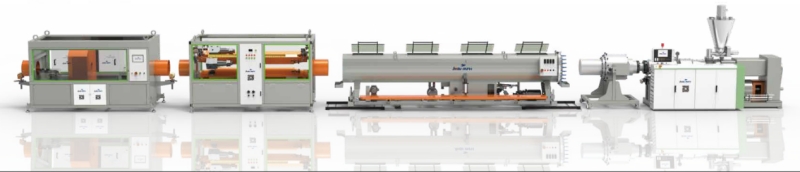
"Increasing efficiency and reducing costs" has always been a core operational objective for plastic pipe manufacturers. JWELL’s high-speed PVC pipe extrusion equipment delivers outstanding performance, providing the industry with highly efficient and reliable solutions. This feature highlights the MFH-F160 PVC pipe production line; combining high output, stability, and automated features, it meets the demands of large-scale manufacturing and helps enterprises strike the optimal balance between efficiency and cost.
Tekniset tiedot
Compatible Pipe Diameter: Ø75–Ø160 mm
Production Capacity: 1,500 kg/h
Key Advantages: High-speed stability, precise temperature control, and automated integration.


High-efficiency plasticization, stable extrusion
Hyödyntämällä a rinnakkainen kaksiruuviekstruuderi with a 36 L/D ratio and a segmented, counter-rotating screw element design, the system employs a variable-pitch configuration tailored to material conditions to enhance mixing uniformity and plasticization; combined with a high-efficiency venting structure, it ensures melt temperature stability, laying the foundation for consistent, high-output production.
Upstream extrusion auxiliary equipment includes a high-speed mixing unit and an in-line loss-in-weight feeder. The high-speed mixing unit enables rapid material blending and drying, while the cooling and agitation stage effectively prevents material agglomeration, ensuring stable feeding. The in-line loss-in-weight feeder controls linear weight and incorporates anti-surge and anti-bridging designs to achieve precise in-line material proportioning, significantly enhancing production efficiency and product consistency.
Rapid Forming and Cooling System
The extrusion die employs a proven spider-type structure; the flow channel is optimized to ensure uniform melt distribution, thereby enhancing pipe forming precision and surface finish. The system combines vacuum cooling with a water-ring water-curtain cooling setup, featuring high-precision filtration and automatic water level and temperature controls to achieve rapid, uniform cooling and ensure dimensional stability of the pipe.
Intelligent Haul-off and Cutting System
Utilizing servo-linked control technology, the system achieves precise synchronization between hauling and cutting, with a wide, flexible adjustment range for haul-off speed ratios to meet production requirements for various pipe diameters. The cutting unit features an integrated design combining chip-free cutting and dust-free chamfering; it ensures cutting precision even during high-speed operation and minimizes manual intervention, thereby comprehensively enhancing the automation level and operational stability of the entire production line.
Sisällysluettelo
- Selecting the Right High-Temperature Resistant Impact Modifier JWELL upvc pipe extrusion machine
- Precisely control the degree of plasticization.
- Optimize lubrication balance to suit the high-viscosity characteristics of CPVC.
- High-efficiency plasticization, stable extrusion
- Rapid Forming and Cooling System
- Intelligent Haul-off and Cutting System
Changzhou Jwell Machinery Co., Ltd. Vuonna 1997 perustettu JWELL on ollut Kiinan suulakepuristusteollisuuden kärjessä yli 15 peräkkäisen vuoden ajan. Maailmanlaajuisena suulakepuristusteknologian kokonaisratkaisujen toimittajana JWELLillä on pitkä historia ja rikas teknologiakertymä. Yli 1 1,016 patentilla ja 9 tuotantolaitoksella. Kestävyyteen panostaminen, innovaatioihin pyrkiminen ja asiakaskokemukseen keskittyminen ovat JWELLin pysyvä yrittäjähenki. JWELLin ihmiset kohtaavat aktiivisesti uusia teollisia haasteita sekä uusia materiaaleja ja prosesseja. Nopeutamme jatkuvasti uusien teknologioiden tutkimusta ja kehitystä, keskitymme uusiin energiankäyttötarkoituksiin, kevyisiin autojen komposiittimateriaaleihin sekä lääketieteellisiin kertakäyttötuotteisiin ja lääketieteellisiin pakkauksiin. Sitoudumme muovinjalostuksen ja kierrätyksen huipputeknologiaan. Innovoimme ja kehitämme jatkuvasti suulakepuristuslaitteita polymeerien jakelualalla. JWELLillä on moderni kokoonpanotyöpaja, 9 suurten komponenttien työpajaa ja tarkkuus-CNC-koneita. Ainutlaatuisen prosessointiteknologian avulla pyrimme varmistamaan jokaisen komponentin vakauden. Kiinnitämme huomiota osien tarkastukseen ja laadunvalvontaan ja varmistamme kaikkien osien tarkkuuden ja luotettavuuden. Laatu on erinomainen, täydellinen kokonaisuus. Poikkeuksellinen asiakastyytyväisyys. Ymmärrämme ja kunnioitamme asiakkaidemme visiota ja strategiaa. Ammattitaidollamme ja omistautumisellamme parannamme jatkuvasti tuotteidemme laatua, tarjoamme asiakkaille kokonaisvaltaisia ratkaisuja. Ja luomme jatkuvasti arvoa asiakkaille.


